 |
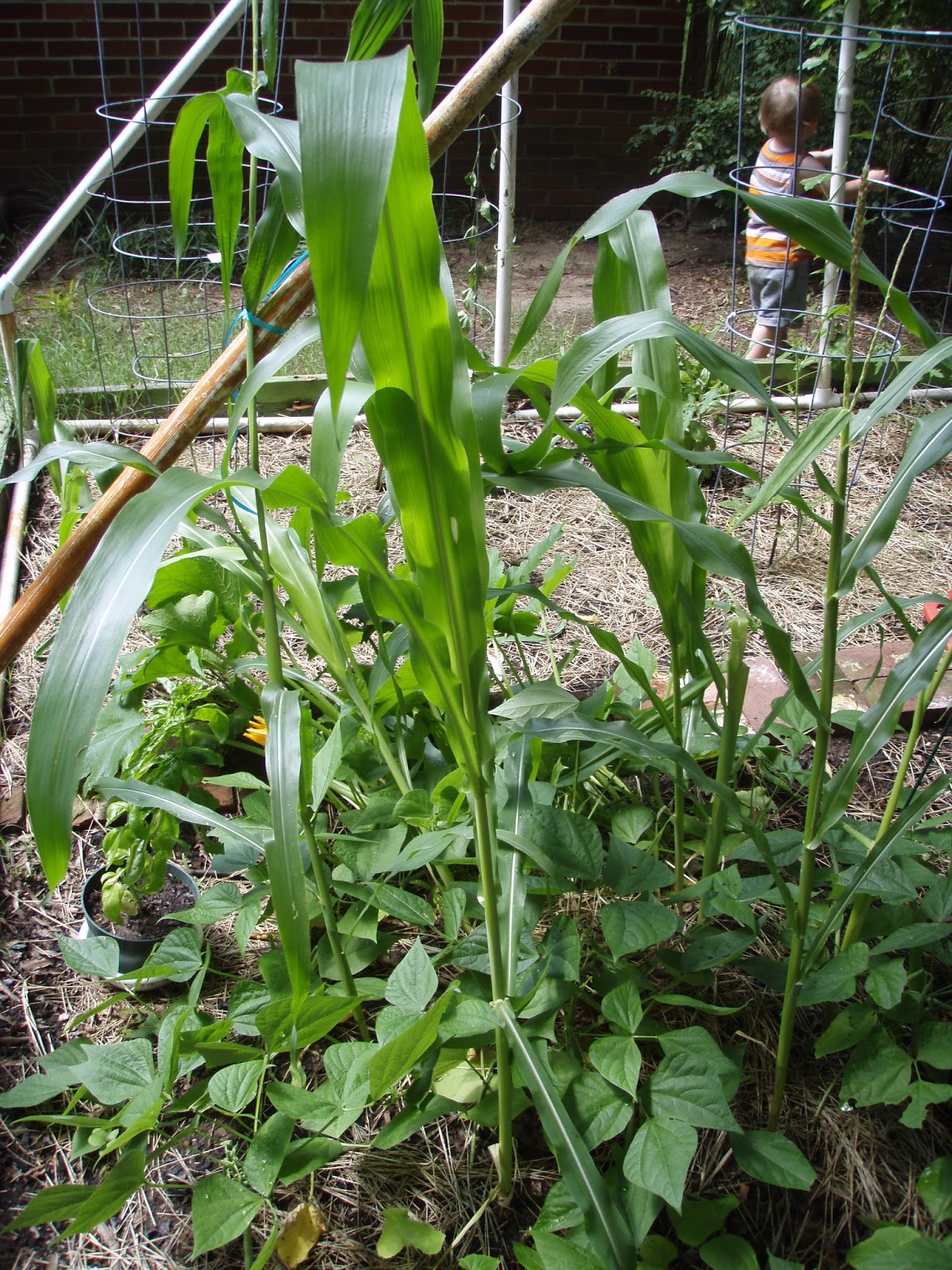
| My beans are growing in a "three sisters" mound. You can read more about this in my post about planting the three sisters. |
Showing posts with label mini-farming. Show all posts
Showing posts with label mini-farming. Show all posts
Friday, June 17, 2016
First Vegetable Harvest: Beans from Bush to Plate
I was so excited today to walk in my garden after a long weekend away and find the bush beans had gone from blooming to bearing. I have some photos to show the "processing" of the beans from garden picking to preparing for lunch.

Wednesday, June 15, 2016
Planting the Three Sisters
In the Americas long ago, and even modern day in some cultures, people relied on the Three Sisters to feed themselves. The sisters are corn, squash, and beans. This combination has proven to be a secret to balancing a diet when consumed together. The good news, is they thrive when they are planted together.

I have read about this often as I taught Native American History to elementary students. I was always fascinated by the knowledge that cultures had so long ago. I remember reading about how Squanto had helped the Europeans farm successfully, teaching them to plant fish under the corn seeds in a mound. Now, we buy special fertilizers made from fish emulsions to avoid chemical fertilizers. Listening to the past can be so valuable.

I have read about this often as I taught Native American History to elementary students. I was always fascinated by the knowledge that cultures had so long ago. I remember reading about how Squanto had helped the Europeans farm successfully, teaching them to plant fish under the corn seeds in a mound. Now, we buy special fertilizers made from fish emulsions to avoid chemical fertilizers. Listening to the past can be so valuable.
Tuesday, June 25, 2013
Green Beans, Dryer Balls, and Bees
Summer vacation after my first full year of teaching is somewhat bittersweet. It is too short and I'm too tired! But, alas, after an entire week of doing absolutely nothing, I have gotten back on track with my goal to use this time wisely to improve our sustainable living habits.
Although today was not our first harvest from the mini-farm, it is the most promising. With dozens of green tomatoes waiting to ripen, several melon blossoms waiting to pollinate, and tiny crowns of broccoli waiting to grow, the future looks mighty tasty. There are a few orange tomatoes, but the harvest of today is from my Kentucky Wonder Pole beans. A few weeks ago, I plucked a single green bean from the vine and graciously offered it to our sugar gliders. They were thrilled. Today, I received seven green beans. Just enough for a good side to my dinner. These are more plump than the haricot vert you typically get at a Chinese restaurant, so you need less of them. My favorite way to eat them, however, does follow the Chinese tradition. I simply blanch them for one to two minutes (basically place them in a pot of boiling water) or until the green color seems the brightest. Then I put them in a frying pan with either butter or sunflower oil and some browned garlic. Eat 'em while they're hot!
Something I have always wanted to try is using wool dryer balls. I have heard great things about them. They apparently tumble out the static from your clothes, they decrease drying time by creating
 air pockets between clothing, and if you put essential oils on them, they are as good as scented dryer sheets but better for the environment and your family. The downside: to get four of these things it is almost $40. Well, for $8.24 I bought wool yarn, and for free, I looked up the directions on how to make them! Here is the link to the actual site where I learned how to make them: http://www.seasonedhomemaker.com/2012/11/how-to-make-felted-wool-dryer-balls.html. I pinned this after coming across it on another site that I am officially in love with: http://thehomesteadsurvival.com/. They also have a facebook page. Anyways, I have created six dryer balls and still had some yarn left over. Laundry day is Sunday in our house, so we will see how they work out.
Lastly, I wanted to update the beekeeping events of late. My husband and I discovered that the bees have been so productive, that they had nearly filled the entire hive. Four medium hive boxes had all been drawn out with comb and filled, two with brood, and two with honey! To give them some more space we removed one of the frames from one honey super (really...it was for their space...not for the desire to have honey...really). Currently it sits in the freezer, because we are not sure which is the best way to extract the honey just yet. Our investment in this project has been higher than expected and we really don't want to invest in extracting equipment just yet. We had read that it would be a year before we would be able to take from them. So we had some decision making to do in regards to the hive.
Our mentor told us that we should go ahead and put in another brood box and add two more honey
 supers. This requires a little more investment as well. We had already ordered a single box when we were able to reach her, and the shipping is not cheap. She also told us that only one honey super needs to remain for the bees over the winter. (If we also intended to provide sugar water.) To be on the safe side, however, we have decided to keep the hive small this year. While having eight hive boxes might be a reality at some point, it is a little more than we can handle right now. Besides, the queen seems to be laying at a good rate and there appear to be bees in all stages of life present: egg, larva, pupa, bee. It appears that she is handling the space just fine. So, today I have added the new box as a honey super. Our goal is to leave them with two honey supers for the winter and harvest one for ourselves. That still gives us about 30 lbs of honey!
We are very excited and happy about what we have accomplished already this year. We drive by two locations in our area with bee hives, and in comparison, ours appears much more active and healthy. It might be because they are new and healthy, but it also might be some of our own skill and care.
Happy Homesteading!
Although today was not our first harvest from the mini-farm, it is the most promising. With dozens of green tomatoes waiting to ripen, several melon blossoms waiting to pollinate, and tiny crowns of broccoli waiting to grow, the future looks mighty tasty. There are a few orange tomatoes, but the harvest of today is from my Kentucky Wonder Pole beans. A few weeks ago, I plucked a single green bean from the vine and graciously offered it to our sugar gliders. They were thrilled. Today, I received seven green beans. Just enough for a good side to my dinner. These are more plump than the haricot vert you typically get at a Chinese restaurant, so you need less of them. My favorite way to eat them, however, does follow the Chinese tradition. I simply blanch them for one to two minutes (basically place them in a pot of boiling water) or until the green color seems the brightest. Then I put them in a frying pan with either butter or sunflower oil and some browned garlic. Eat 'em while they're hot!
Something I have always wanted to try is using wool dryer balls. I have heard great things about them. They apparently tumble out the static from your clothes, they decrease drying time by creating

Lastly, I wanted to update the beekeeping events of late. My husband and I discovered that the bees have been so productive, that they had nearly filled the entire hive. Four medium hive boxes had all been drawn out with comb and filled, two with brood, and two with honey! To give them some more space we removed one of the frames from one honey super (really...it was for their space...not for the desire to have honey...really). Currently it sits in the freezer, because we are not sure which is the best way to extract the honey just yet. Our investment in this project has been higher than expected and we really don't want to invest in extracting equipment just yet. We had read that it would be a year before we would be able to take from them. So we had some decision making to do in regards to the hive.
Our mentor told us that we should go ahead and put in another brood box and add two more honey

We are very excited and happy about what we have accomplished already this year. We drive by two locations in our area with bee hives, and in comparison, ours appears much more active and healthy. It might be because they are new and healthy, but it also might be some of our own skill and care.
Happy Homesteading!
Wednesday, April 10, 2013
Spring Work and Its Rewards

― John Muir, The Wilderness World of John Muir
Well, it's not all joyful, but most of it is. It has been an interesting seasonal transition to say the least. My first round of seedlings, planted according to the earliest start date for transplants, did not last very long at all. Quickly, I adjusted my planting calendar in my journal and started a second batch. Now that batch has also perished. I have never had much luck sprouting seedlings indoors. I think I will just go ahead and purchase some tomato and broccoli transplants. The good news is, I have an abundance of life happening outside!
On a beautiful afternoon (March 29) I began planting some outdoors seedlings. 50 potatoes (19 small yellow, 13 red, and 18 large yellow), 4 square feet of carrots, 2.5 square feet of lettuce, 16 green beans, and a second round of 21 spinach. Today, all of these were showing beautiful green signs of life. Of course, this downpour/tornado tonight is not very promising, but at least I took photos to prove I didn't do it all wrong! Surely everything will do fine. They all survived the hail just two days after being planted, and a few nights near freezing.
In addition to edibles, I splurged a little on some annuals and an azalea, in preparation for my bees. I picked a semi-shady bed where I have had little luck, so I chose light colored begonias and some petunias. From my time spent working for a landscape architect (a very good one), I learned a few things. One thing is that plants can sometimes be like people. For example, there are different types

Now for the most joyful, enthusiastic news: we have bees! At the April Lady Beekeeper's Association meeting I gave a nuc box complete with 5 frames to the president. She had promised a swarm for me and I wanted to be prepared. Then, just two days ago, on the way home, I got the call. "Stephanie, we have your bees. You can come get them today." So off we went, bee suit at the ready, and jumped in my husband's car (I drive a hatchback, which is no good for transporting a box of bees, unless you want to drive in your bee suit...). We arrived to find the bees neatly packed in a box and tied with a piece of twine. Just like a beautiful, buzzing present. After some discussion, we headed home where they were set atop our hive to spend the night. To keep them fed while they were enclosed, we mixed 4 lbs of sugar with 1 gallon of water, heated until dissolved, then put in a spray bottle, and sprayed the bees through the air vents.

Once my husband arrived, we lit the smoker, prepared two feeders with the sugar-water solution, and took all our gear outside. The moving process was fairly easy. It was very exciting, but we were both nervous. At one point, my husband even mentioned that his confidence was not as high as when we had our "mentors" with us. In fact, we video taped the entire process and I realized while watching it later that I got a little too happy with the sugar water and probably overdosed everyone in a five mile radius on sugar. The good news is we got all the frames into the hive, added some more empty frames to fill up both hive boxes, and put everything back. Naturally, there were some bees who did not make it inside the box with the frames, but by dark, most had found their way into the hive and were safe and secure.
Subscribe to:
Posts (Atom)